THE ORIGINAL VIDEO
Watch Natalie Stringfield
Transform Your Space: IKEA PAX Wardrobe Makeover Secrets Revealed! I saved THOUSANDS! · 33:42
Watch on YouTube ↗ · Video by Natalie Stringfield
Video chapters
Count the clothes before choosing the frames
Natalie’s most useful planning advice comes before the decorative touches: clear out what you no longer use and count the clothes, shoes, bags and accessories that remain. A wardrobe designed around an imaginary future collection can waste as much space as an overcrowded one. Start with your actual hanging lengths, folded stacks and shoe heights.
Make three groups: everyday items, occasional pieces and things kept for sentimental reasons. Your daily clothes should not be behind occasionwear or buried under packaging. Leave spare capacity deliberately, but do not turn every empty shelf into a shopping prompt. In a shared wardrobe, give each person a defined section before dividing the remaining space by garment type.
Measure the room, then the moving parts
The creator describes an 8-by-10-foot closet and uses PAX frames of different widths. Those measurements belong to her room. For your own plan, record the wall width at several heights, ceiling clearance, skirting boards, sockets, switches and any ventilation grille. Note the entrance-door swing and the space needed to stand in front of an open drawer.
Use the local IKEA planner and the dimensions of the exact products sold in your market. Tape the proposed footprint on the floor before ordering. A layout can fit on a wall and still make the room awkward when a drawer or hinged door is open. Take photographs of corners and obstructions to a planning appointment so the conversation is about the actual room rather than a simplified rectangle.
Where glass earns its place
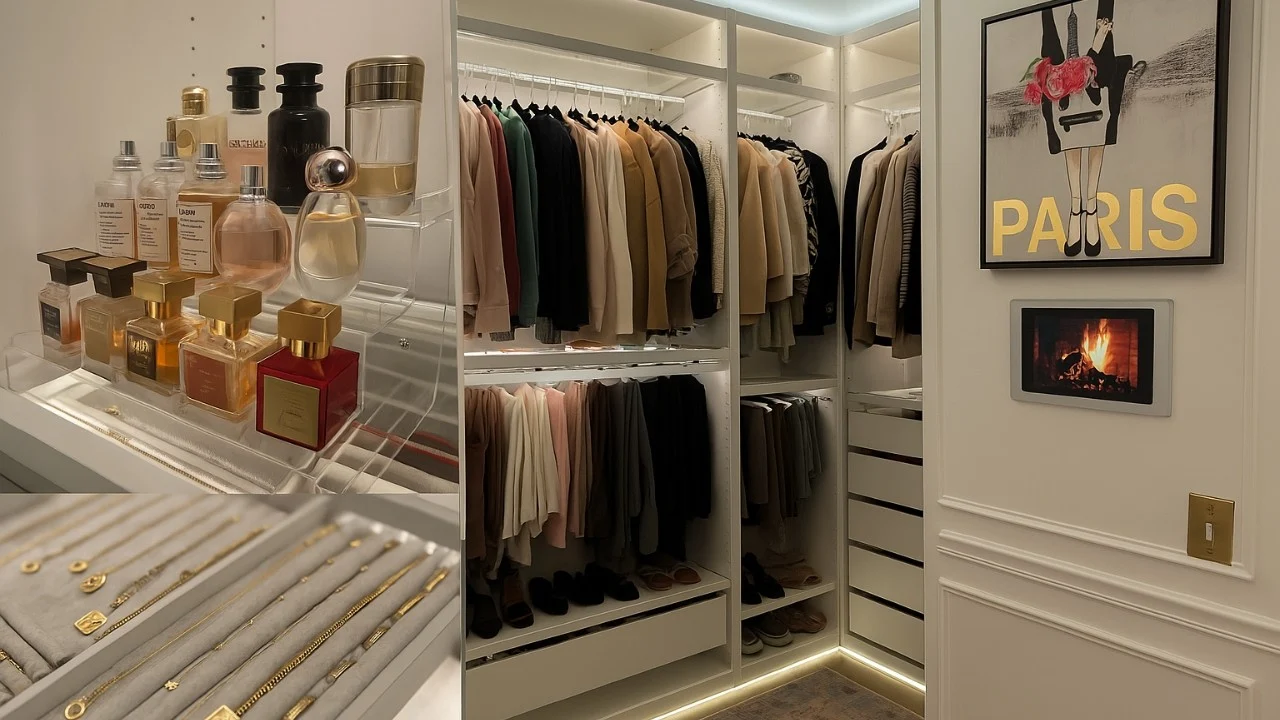
Glass shelves and drawer fronts give Natalie’s closet its display quality, while pull-out trays make smaller accessories visible. Her storage includes jewellery, trousers, bags, shoes and folded clothes. Copy the principle of assigning a place to a category, then choose the accessory that lets you reach it comfortably.
Use a plain shelf for a stack that does not need a specialised fitting. Reserve a divided tray for objects that otherwise tangle or disappear. Put a pair of your tallest shoes and your longest garment beside the plan. Those two objects often reveal whether the design is genuinely usable. For jewellery, a beautiful tray should still have compartments large enough for your actual pieces.
Open shelves versus doors
Natalie says dust is a drawback of her open closet, particularly around the ventilation in her room. The glossy display is only one side of the decision. If you dislike dusting individual bags, perfume bottles and accessories, closed doors may be worth more to you than the open-boutique effect.
Think about what is visible from the bedroom or hallway. You might keep one display bay and close the rest. This also makes it easier to separate daily clothing from things you want to display. Do not block an air-conditioning outlet with a cabinet or decorative trim; have the room layout checked before installation if ventilation clearance is uncertain.
Lighting and the additions outside the wardrobe budget
The video includes wardrobe lighting, additional LED strips, wall moulding, a mirror, a chair and a wall-mounted tablet. These are separate project decisions. Plan cable paths and access to power before assembling the frames. Have electrical additions handled by a qualified installer rather than burying loose extension connections behind cabinetry.
Make a budget with separate lines for frames, interiors, doors, lighting, delivery, assembly, wall fixing and decorative work. Around 6:38, Natalie describes the wardrobe components and lighting as costing under US$3,500 at the time she bought them. That historical figure is not a current Gulf quotation, and the full decorated room includes other purchases. Do not base a new project on a number heard without its scope.
A phased plan you can live with
Phase one is storage: correctly sized frames, safe installation and enough rails or shelves for daily clothes. Phase two is organisation: dividers or trays for the categories that remain difficult to use. Phase three is decorative: lighting, a mirror and finishes. This order makes the wardrobe useful even if the final styling takes several months.
For each phase, keep the product code and assembly instructions. Before paying, check that a frame, drawer, rail and door are compatible—not merely the same colour. In the Gulf, use the store for your delivery country and ask about stock for the complete combination. A frame being available does not mean the matching doors or interior trays are ready for delivery.
THE GULF SHOPPING NOTES
Find your local starting point
Names to look up from the video
- IKEA PAX frames
- KOMPLEMENT interiors
- Glass shelves and drawer fronts
- Pull-out jewellery trays
- Wardrobe lighting
- Full-length mirror
Names are a starting point for comparison. Check the exact variant, size and local listing.
Choose your country before comparing. These are retailer and catalogue links, not live stock confirmations. Prices, sizes, delivery and returns can differ by country. Links reviewed 13 November 2026.
Creator & credits
Original video: Natalie Stringfield. Video and selected stills remain the creator’s work; Fofo Saloon’s guide is independent commentary. No creator affiliation is implied.
Our editorial approach ↗